

First dental visit in Győr – modern, pain-free care.
DENTYS Dental Clinic Győr – premium care, transparent process, confident decisions.
Meeting a new dentist for the first time naturally raises many questions.
On this page we explain – step by step, in clear and professional language: what happens during your first visit at DENTYS:
- how you can book an appointment,
- why we ask detailed questions already at the first contact,
- what to expect at reception,
- which examinations may be necessary,
- when and how you will receive a personalised treatment plan and cost estimate,
- in which situations we can already start or even complete treatment at the first visit, especially in case of acute pain,
- and how we inform you about the nature, risks and alternatives of the proposed procedures – including what may happen if treatment is postponed or not carried out.
What does the “first visit” mean at DENTYS?
For us, a first visit is not just a quick look, but a structured diagnostic and – whenever possible – therapeutic appointment designed to:
- gain a precise understanding of your complaint, its background and your expectations,
- obtain an objective picture of the condition of the teeth, bones and bite using state-of-the-art imaging and digital tools,
- provide a written, personalised treatment plan together with a detailed, transparent cost estimate,
- help you make a decision that offers a safe, aesthetic and functionally reliable solution in the long term.
At our clinic we provide the full spectrum of dental care – from general dentistry through oral surgery, orthodontics and implantology to complex, multi-disciplinary rehabilitative treatments. Accordingly, the structure of the first visit is always tailored to your individual situation.

1. Contact and booking an appointment
You can book an appointment through several channels:
- by phone: +36 70 770 0331
- by email
- online
- via foglaljorvost.hu
If you do not book by phone, please provide a few basic details (for example: nature of the problem, region involved, how long it has been present, intensity of pain). This allows us, when we call you back, to offer real help rather than simply entering an appointment into the calendar.
2. Call-back and pre-assessment – why we ask so many questions

If your appointment request does not come by phone, our front-desk team will call you back. This conversation is much more than pure administration:
- we ask what kind of problem you have (pain, swelling, broken tooth, aesthetic concern, long-postponed treatment, routine check-up, etc.),
- we clarify your expectations (urgent pain relief, long-term solution, aesthetic restoration, time and budget constraints),
- we specifically ask whether you have any acute complaint requiring immediate care.
Based on this:
- we schedule you with the appropriate specialist (restorative dentist, oral surgeon, orthodontist, etc.),
- and we reserve a time slot that – if the clinical situation allows – makes it possible not only to perform diagnostics, but also to start or complete treatment at the same visit.
For patients arriving with severe pain, our key objective is not only to make a diagnosis, but – as far as medically possible – to reduce or eliminate the pain at the very first visit. This is why it is so important that we understand the nature of your complaint already during the initial contact and tailor the appointment accordingly.
3. Appointment confirmation

Your booked appointment will be confirmed both by e-mail and by SMS. The confirmation includes:
- the exact address of the clinic and how to get here,
- parking information,
- the most important details regarding arrival and administration,
- and, where relevant, an indication of whether you should primarily expect a diagnostic / treatment-planning visit or a combination of diagnostics plus likely treatment.
4. Changing or cancelling an appointment
If something unexpected comes up, please inform us as soon as possible, but no later than 24 hours before your appointment time. This allows us to offer the freed time slot to another patient who may be waiting for urgent care.
A short summary of our cancellation policy can be found below; the full details are set out in our General Terms and Conditions (GTC).

5. Arrival at the clinic – please arrive around 15 minutes early

For your first visit we kindly ask you to arrive approximately 15 minutes before the scheduled time, so there is enough calm time for administration. This process takes place at reception and is completely paperless:
- our team will hand you an iPad,
- you unlock the device using your date of birth,
- and then complete two short but content-rich forms:
- patient registration form (personal data and contact details),
- medical history form (anamnesis) – health questionnaire, current medication, previous illnesses, allergies, past procedures.
The detailed rules on data handling and protection are set out in our Privacy Policy.
This step is not a formality: your medical history is the foundation of safe care. It helps us reduce risks, choose the appropriate anaesthesia and medication strategy, and plan the sequence of treatments.
6. Clinical examination, diagnostics and – where possible – immediate treatment
After administration you will be seen for a specialist consultation and full clinical assessment. Depending on the medical indication, this may include:
- panoramic X-ray or CBCT scan (three-dimensional imaging),
- intraoral scanning (digital impressions),
- photographic documentation and bite analysis where needed.
During the examination:
- we discuss your complaint and its history in detail,
- we examine the teeth, gums, oral mucosa and bite,
- using the imaging results we obtain an accurate picture of the bone structure, roots, nerve canals and sinuses,
- we check the condition of existing fillings, crowns, bridges and implants.

In case of acute complaints, provided it is medically feasible and the reserved time allows, we aim to start or perform the necessary treatment immediately at the first visit. For example:
- initiating or medicating root canal treatment of a severely painful tooth,
- extraction of a tooth that cannot be saved,
- first-line management of swelling or infection,
- temporary or definitive restoration of a broken tooth.
If the final, definitive solution requires several stages, we first focus on pain relief and control of inflammation, and schedule the subsequent steps as part of your treatment plan.
7. Personalised treatment plan and cost estimate
Based on the examination findings, your dentist will prepare a written, personalised treatment plan. This is not a generic template, but a professional proposal tailored to your condition, goals and possibilities.
Your treatment plan:
- shows, visit by visit, how often you need to come to the clinic and for what purpose,
- details the individual treatments by tooth, arch and quadrant,
- lists specific fees for each item,
- indicates the expected healing times and follow-up appointments,
- and, where appropriate, presents several alternative options (for example different types of prosthetic restorations or orthodontic approaches).

The plan covers all dental domains relevant in your case, including:
- specialist consultations and diagnostic tests (X-rays, CBCT, intraoral scans),
- dental hygiene procedures (professional scaling, periodontal care),
- tooth-preserving treatments (fillings, root canal therapy, inlays/onlays),
- aesthetic treatments (veneers, aesthetic fillings, smile rehabilitation),
- oral surgery where needed (extractions, bone grafting, sinus lift, implant placement, soft-tissue procedures),
- orthodontic treatment (diagnostics, treatment planning, appliance placement, activations, retention),
- prosthetic work (crowns, bridges, implant-supported restorations),
- regular check-ups and long-term follow-up.
Your treatment plan is:
- discussed with you in person: your dentist explains each step and the rationale behind it,
- provided to you in printed form,
- and also sent electronically by e-mail, so you can review it again at home, in peace.
Our aim is for your plan to be comprehensive, transparent and predictable: you should know how many visits are required, which procedures will take place, how much they will cost, how long healing is likely to take, and what aesthetic, functional and speech-related outcomes you can expect.
Technological background: why it already matters at the first visit
Our diagnostic work is supported by a modern, high-precision equipment park:
- Panoramic and CBCT (3D) imaging for the precise mapping of bone and root morphology, nerve canals and sinuses,
- Intraoral scanner for digital impressions and micron-level 3D models without uncomfortable impression materials,
- Digital treatment planning for implant, prosthetic and aesthetic cases,
- Optimised radiation dose protocols – all imaging is performed only when medically indicated and with the minimum necessary dose.
Diagnostic protocols are individualised in every case and based on medical indication; we do not sell “packages”, but make decisions guided by professional necessity.

FAQ & Good to Know
Information, consent and documentation: how we protect your rights
Paperless digital consent forms
Our clinic operates with fully paperless documentation: all necessary information sheets and consent forms are displayed on an iPad, and you sign them electronically.
Within our internal digital practice management system we use multiple, specifically tailored consent templates that have been reviewed both legally and clinically for different situations, for example:
- tooth extraction and wisdom tooth removal,
- root canal treatment and apicoectomy (root-end resection),
- implant placement, bone grafting and sinus lift,
- orthodontic treatments,
- tooth whitening and aesthetic procedures,
- periodontal surgery,
- fixed and removable prosthetic restorations.
Where needed, we can also send these documents by e-mail, so you can review the agreed treatments and the corresponding information at any time.
From a legal perspective, your electronic signature has the same validity as a handwritten signature, and all documents are stored securely and for the legally required period, in line with healthcare and data-protection regulations.
What do our information sheets cover?
Depending on the type of procedure, our information materials typically include:
What exactly will we do?
A clear description of the treatment steps (e.g. how an extraction is carried out, stages of root canal treatment, implant placement, bone grafting, placement of an orthodontic appliance, etc.).
Why are we doing it?
We explain the purpose of the procedure, such as:
- relief of pain and control of infection,
- restoration of chewing function,
- aesthetic and smile rehabilitation,
- long-term stability of bone and soft tissues (bone and gum),
- improvement in speech and phonation.
What are the possible risks?
We speak honestly about potential risks and complications (for example post-operative bleeding, swelling, pain, temporary sensory disturbance, infection, failure of root canal treatment, implant loss, transient sensitivity or tooth movement during orthodontic treatment, the need for retention, etc.).
We emphasise that these events are uncommon, but can happen, and we always discuss what we do to minimise them and how we manage them if they occur.
What alternatives are available?
If clinically meaningful alternatives exist, we outline them – for example:
- extraction plus implant vs. bridge vs. removable denture,
- different orthodontic techniques,
- different crown/bridge materials,
- more conservative vs. more extensive surgical approaches.
What happens if treatment is postponed or not carried out?
We also explain the possible short- and long-term consequences of delaying or omitting treatment, such as:
- untreated caries → more extensive damage, later need for root canal treatment or tooth loss,
- extracted but not replaced tooth → tooth migration, bite changes, TMJ problems, bone loss in the affected region,
- untreated malocclusion → worsening bite relationships, accelerated tooth wear, cleaning difficulties, aesthetic and speech disadvantages,
- untreated periodontal disease → progressive bone loss, tooth mobility, tooth loss, bad breath, and in some cases systemic health risks.
DEPOSITS, GUARANTEES, CANCELLATION & FAQ
You can access our detailed information on how to continue the process by clicking the button below.
Our dentistry in pictures


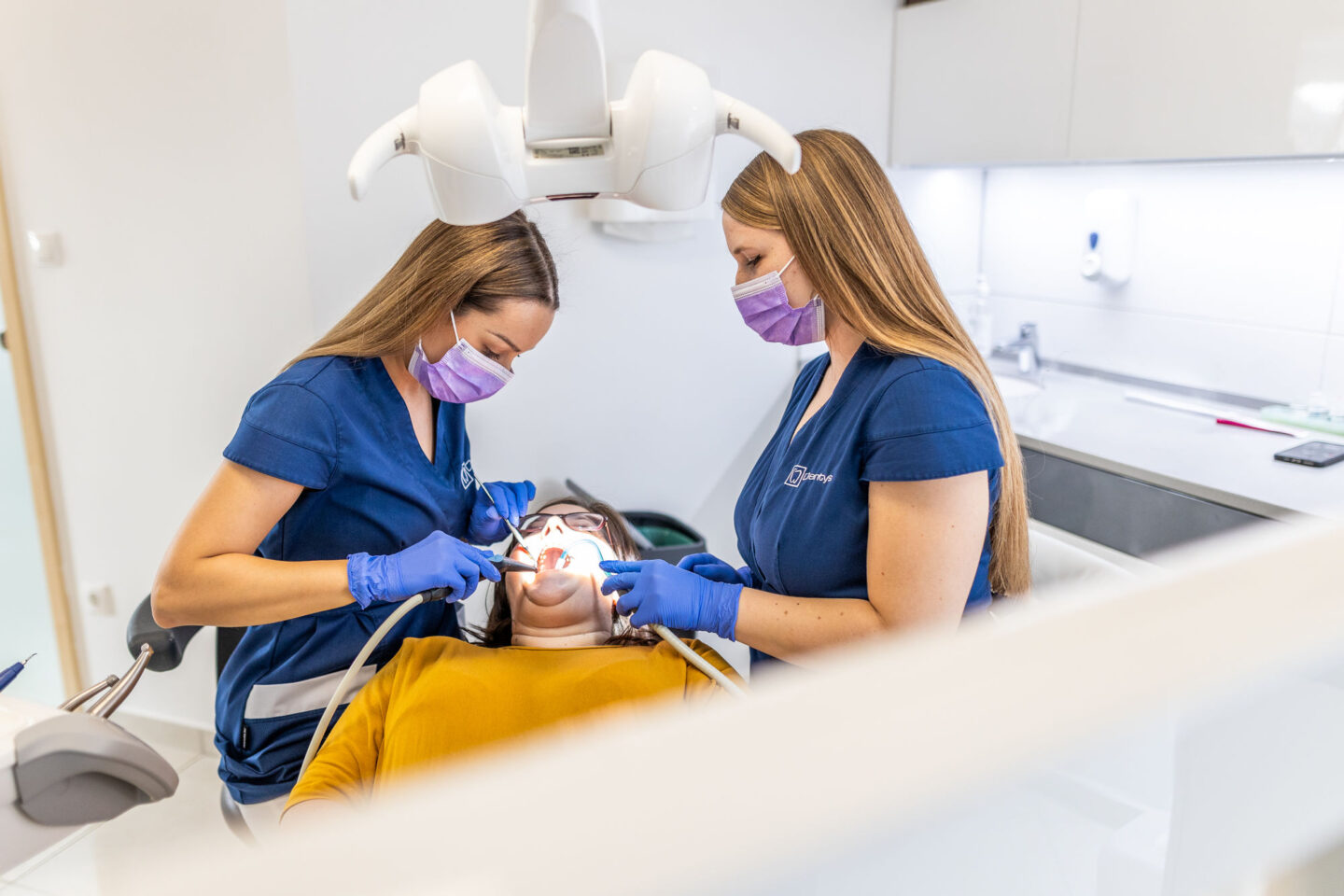


With us, a smile is not only beautiful, but also timeless!
We guarantee our dental treatments for 1-5 years because we believe in quality and your satisfaction.
Whether it’s an aesthetic procedure or a more serious dental problem, you can be sure of a lasting and reliable result.
Detailed information in the Terms & Conditions.